

Everbearing Strawberry
Everbearing Strawberry
*F1 (First Filial Generation) varieties refer to the first generation offspring produced by crossing two pure-line parents. These varieties usually exhibit "hybrid vigor," meaning they outperform their parents in terms of growth vigor, fruit quality, and disease resistance.


 |
The type of soil used varies depending on the product; please determine this based on the soil you have. Before placing the seeds, ensure the soil is moist. You can do this by using the following methods: |
 |
1 | Place the soil in a container and add waterPlace the potting soil into a flowerpot or container, slowly pour in water, and use chopsticks to thoroughly stir the soil to moisten it. |
 |
2 | Put the soil into a bag and add waterFill the bag with potting soil, then slowly pour in water until the soil is moist. |
Planting tips:
It is recommended to sow 1/3 of the seed quantity first (e.g., sow 3 out of 9 seeds) to maintain proper spacing. After the seedlings emerge, thin them out as needed, removing weak seedlings and keeping the strongest plants to provide more growing space.


Basic Planting Guidelines for Everbearing Strawberry
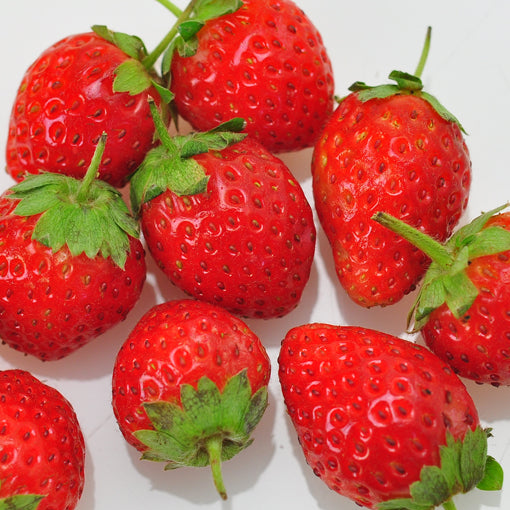
This is an F1 variety of everbearing strawberry, characterized by continuous flowering. The flowers are lovely and have a long blooming period, making it suitable for potted plants or garden cultivation. The fruit is approximately 2-3 cm in size, classifying it as a medium-sized strawberry. Due to its relatively complex management, it is recommended for gardening enthusiasts with some cultivation experience.
*F1 (First Filial Generation) varieties refer to the first generation offspring produced by crossing two pure-line parents. These varieties usually exhibit "hybrid vigor," meaning they outperform their parents in terms of growth vigor, fruit quality, and disease resistance.
|
Ideal ambient temperature: around 20~25°C. |
Do not change the water before germination Do not change the water used to soak the seeds before they germinate. |
|
Before germination, in water Keep the seeds submerged in water until they sprout . |
Buds facing upwards When sowing germinated seeds into the soil, it is essential to ensure that the bud (or sprout) is facing upwards . |


2-1 Germinate the seeds in the jelly (gel)!
 |
Fully soaked in waterFill a cup or other container with water and place the dried strawberry seeds inside. ※ Do not change the water before germination; keep the plant still. ※ If you need to add water, please use clean water that has been left to stand and whose temperature is the same as the original water temperature . |
 |
Not only the roots, but also the cotyledons (double leaves) extend out of the jelly/gel before being buried in the soil. The left ( X ) region only has the root point. It is not suitable for transplantation. The root ( O ) has grown, and the cotyledons have begun to emerge. It is ready for transplanting. The right ( O ) root is long and intact, and the cotyledons are fully formed and extended. Suitable for transplanting. |
Methods of burying seeds (2 ways)
 |
General principles:Please plant the seeds, ensuring that the cotyledons (double leaves) emerge from the soil . * At this point, be sure to completely bury the jelly/gel portion in the soil . If it remains exposed, the jelly will dry and harden. For buds that have completely detached from the jelly, gently plant them in the same way using tools such as tweezers . |
 |
A. Planting method: Allow the bud to protrude above the soil surface.■ Let the buds emerge from the soil surfaceOnce the seed germinates and the cotyledons emerge from the jelly, expose the cotyledons above the soil surface, planting it just at the edge of the soil surface. |
 |
B. Implantation method: Insert the bud with the bud facing upwards.■ Bury with the bud facing upwardsOnce the seed germinates and the cotyledons emerge, plant it with the cotyledons facing upwards , just at the edge of the soil surface. ※ Be careful not to cover it with too much soil . |
Post-germination management
Watering (continued from the previous illustration)
Watering should be done gently after germination and during the early growth stage to avoid wetting the leaves. Water thoroughly only after the soil surface has completely dried.
 |
Thinning (shortening seedlings)Thin out the seedlings, leaving only one. When the seedlings have grown about 4 to 5 true leaves , thin them out, leaving only one plant . ※ Timeframe: Approximately one to one and a half months after germination. |
 |
FertilizationFertilize after true leaves have grown and the plant has stabilized. Please place the fertilizer around the edge of the flowerpot or around the roots . * Timeframe: Approximately 4 to 5 months after sowing the seeds. |
 |
Cut the stemCut off the runners If runners grow out, please prune them from the base frequently. |
 |
pollinationPollination is carried out after flowering. When the flowers begin to bloom, use a brush or cotton swab to gently rub the inside of the flower to artificially pollinate it. |
 |
HarvestingThe fruit can be harvested when it turns red. |
Reasons for germination failure
Reason 1: Temperature
The germination temperature is 20-25℃.
Is the temperature guaranteed to be within this range?
Adding water or performing other operations midway through germination may cause the water temperature to drop, resulting in germination failure. (This underscores the importance of stable water temperature.)
Reason 2: Water volume
Is the jelly/gel hardened because of insufficient water?
Please soak in plenty of water . (It is important to ensure there is enough water to maintain the jelly-like or soaking state.)
Reason 3: Individual differences in seeds
If the seeds are too old, the germination rate will be poor.


After germination and in the early stages of planting, water gently with a thin stream of water (such as a spray bottle) to avoid washing away the seedlings with a strong flow. Water thoroughly when the soil surface is dry.

Why didn't the seed sprout? Let us help you find out the reason.

Reason 1: Overwatering (root rot)
Reason 1: Overwatering (root rot)
Another reason is over-care and excessive daily watering.
If the soil is too wet, the roots cannot breathe and will rot and die. The roots will shrink and disappear, turn brown, and become thin and fragile.

Reason 2: Dryness
If you forget to water your plants, the soil will dry out and the plants will wither.
The leaves will become dry and brittle.
If there is still moisture in the leaves, water them thoroughly.
They might be able to recover.

Reason 3: Lack of sunlight (Extended)
If the seedlings do not receive enough sunlight after germination, the stems will grow too quickly and eventually break under the weight of the flower heads, causing the plant to wither. Make sure the plant receives ample sunlight and avoid overwatering.

Reason 4: The temperature is not suitable
Every plant has its optimal growth temperature.
Both excessively high and low temperatures can slow down plant growth and even cause plants to wither.


Germination Guarantee
Did your seeds fail to germinate? Don't worry! Please contact us anytime, and we will send you replacement seeds free of charge. Your gardening experience is our top priority.