

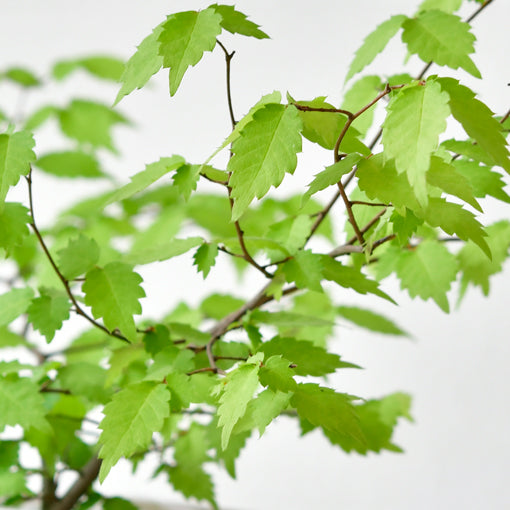
Zelkova serrata
Zelkova serrata
The flower language of beech is "luck" and "longevity".


 |
The type of soil used varies depending on the product; please determine this based on the soil you have. Before placing the seeds, ensure the soil is moist. You can do this by using the following methods: |
 |
1 | Place the soil in a container and add waterPlace the potting soil into a flowerpot or container, slowly pour in water, and use chopsticks to thoroughly stir the soil to moisten it. |
 |
2 | Put the soil into a bag and add waterFill the bag with potting soil, then slowly pour in water until the soil is moist. |
Planting tips:
It is recommended to sow 1/3 of the seed quantity first (e.g., sow 3 out of 9 seeds) to maintain proper spacing. After the seedlings emerge, thin them out as needed, removing weak seedlings and keeping the strongest plants to provide more growing space.


Basic Planting Guidelines for Zelkova serrata
Beech is a deciduous broad-leaved tree with branches that extend outward in a fan shape, forming a unique and beautiful tree shape. It is often used for planting or as a street tree.
The flower language of beech is "luck" and "longevity".
|
Please place the seeds in the refrigerator for **1 to 3 months (about 100 days is recommended)** for low-temperature treatment before sowing. |
Optimal germination temperature: 15–20℃ . (※Please calculate backwards to ensure the temperature reaches this range before sowing.) |
|
Make sure the seeds are covered with soil. The depth shown in the diagram is approximately 5mm. |
To prevent the soil from drying out, lightly covering it with a layer of plastic wrap (or plastic film) will help it germinate. Once it sprouts, remove the plastic wrap immediately. |


|
Dig holes: Dig small holes about 5 mm deep, the same number as the number of seeds. Sowing and covering: Place one seed in each hole, then cover the surrounding soil with soil. |
potting soil |
|
Dig holes: Dig small holes about 5 mm deep, the same number as the number of seeds. Sowing and covering with soil: Place one seed in each hole, then cover the surrounding soil with soil. |
potting soil |


Post-germination management
• Place the plant in a bright, warm location and ensure adequate (at least half a day) sunlight and ventilation.
• Beechwood is not heat-resistant; please keep it in a cool place.
• Watering: Water thoroughly only when the soil surface is dry.
 |
Thinning (shortening seedlings)Thin the seedlings to 1 plant per seedling. When the plant grows true leaves , keep only one healthy seedling and remove the others. |
 |
Placement location Place the plant in a bright, warm location and ensure it receives adequate (at least half a day) of sunlight and ventilation. |
Precautions for use
- Please take extra care to prevent children or pets from accidentally ingesting the seeds or soil.
- Do not use the seeds for food or animal feed.
Growth conditions and cultivation results will vary depending on the cultivation environment, such as climate, region, and altitude.
- Cultivation time is for reference only. It is recommended to sow at a suitable temperature and cultivate according to your local conditions.
- Avoid sowing during the harsh winter and hot summer months; choose a time when management is easier. (If the optimal temperature for germination and cultivation is not reached, the seeds may not germinate or grow poorly.)
Before you begin cultivation, keep the seeds away from direct sunlight, high temperatures and humidity, and store them in a cool, shady place.
Plants need sunlight to grow. Please cultivate them in a sunny location (such as a balcony or near a window).


After germination and in the early stages of planting, water gently with a thin stream of water (such as a spray bottle) to avoid washing away the seedlings with a strong flow. Water thoroughly when the soil surface is dry.

Why didn't the seed sprout? Let us help you find out the reason.

Reason 1: Overwatering (root rot)
Reason 1: Overwatering (root rot)
Another reason is over-care and excessive daily watering.
If the soil is too wet, the roots cannot breathe and will rot and die. The roots will shrink and disappear, turn brown, and become thin and fragile.

Reason 2: Dryness
If you forget to water your plants, the soil will dry out and the plants will wither.
The leaves will become dry and brittle.
If there is still moisture in the leaves, water them thoroughly.
They might be able to recover.

Reason 3: Lack of sunlight (Extended)
If the seedlings do not receive enough sunlight after germination, the stems will grow too quickly and eventually break under the weight of the flower heads, causing the plant to wither. Make sure the plant receives ample sunlight and avoid overwatering.

Reason 4: The temperature is not suitable
Every plant has its optimal growth temperature.
Both excessively high and low temperatures can slow down plant growth and even cause plants to wither.


Germination Guarantee
Did your seeds fail to germinate? Don't worry! Please contact us anytime, and we will send you replacement seeds free of charge. Your gardening experience is our top priority.